
What Is a CTF, and Why Should Your Team Play One?
Capture The Flag competitions are one of the best ways to learn security and to train a team together. What a flag is, the main CTF formats and categories, the skills they build, how to get started, and how a CTF works on the FortMind platform.
If you have spent any time around security people, you have heard someone say they were "up all night on a CTF". It sounds like a hobby for experts. It isn't. A CTF is one of the most beginner-friendly ways to learn security, and one of the most effective ways for a team to practise together.
This guide explains what a CTF is, the different formats, what skills it actually builds, why companies run them, and how to get started without getting lost. At the end, we show how a CTF works on the FortMind platform.
What Is a CTF?
CTF stands for Capture The Flag. It is a security competition where players solve challenges to find hidden pieces of text called flags.
A flag is a secret string, usually in a recognisable format such as CTF{s0me_s3cret_text}. It is hidden somewhere you can only reach by solving the challenge: inside a vulnerable web application, buried in a network capture, encrypted with a weak cipher, or sitting on a machine you have to break into. When you find it, you submit it to the platform, and if it is correct you get points.
That is the whole idea. The challenges are designed, legal, and contained. Nothing real gets hurt, and every target exists so that you can attack it.
Three Ways to Play
Not every CTF works the same way. There are three common formats.
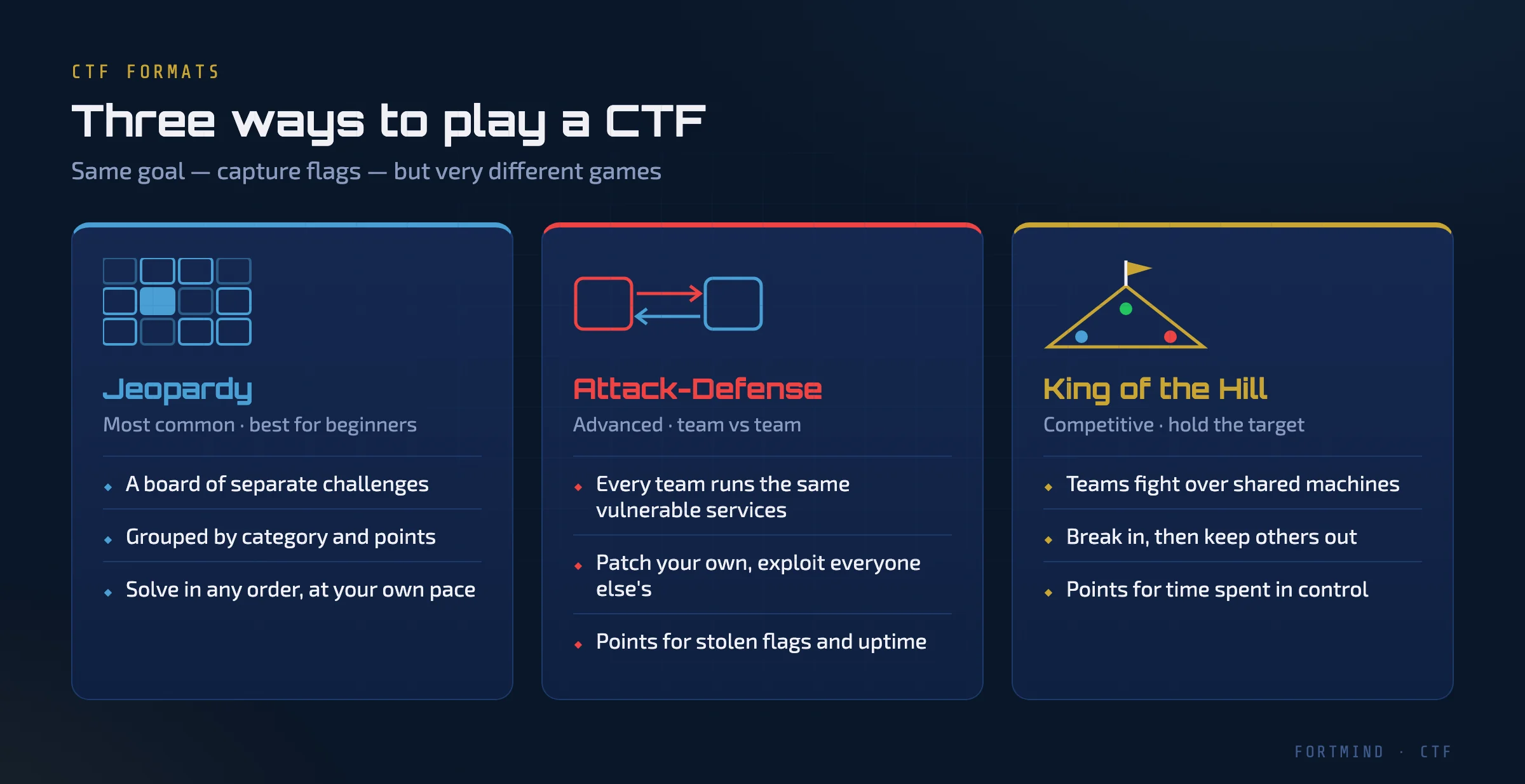
Jeopardy-style is the most common and the best place to start. Players see a board of independent challenges, grouped by category and worth different points. You can pick any challenge, in any order. Harder challenges are worth more.
Attack-defense is a team-versus-team format for more experienced players. Every team runs the same set of vulnerable services. You score by stealing flags from other teams' services, and you lose points when your own services are broken into or go down. You have to attack and defend at the same time.
King of the hill puts teams in a fight over shared machines. You break into a target, then try to keep everyone else out. Points come from how long you hold control.
Most beginner and corporate events use the Jeopardy format, because each challenge stands alone and players can work at their own pace.
What Kind of Challenges Will I See?
In a Jeopardy CTF, challenges are sorted into categories. Each one trains a different part of security.
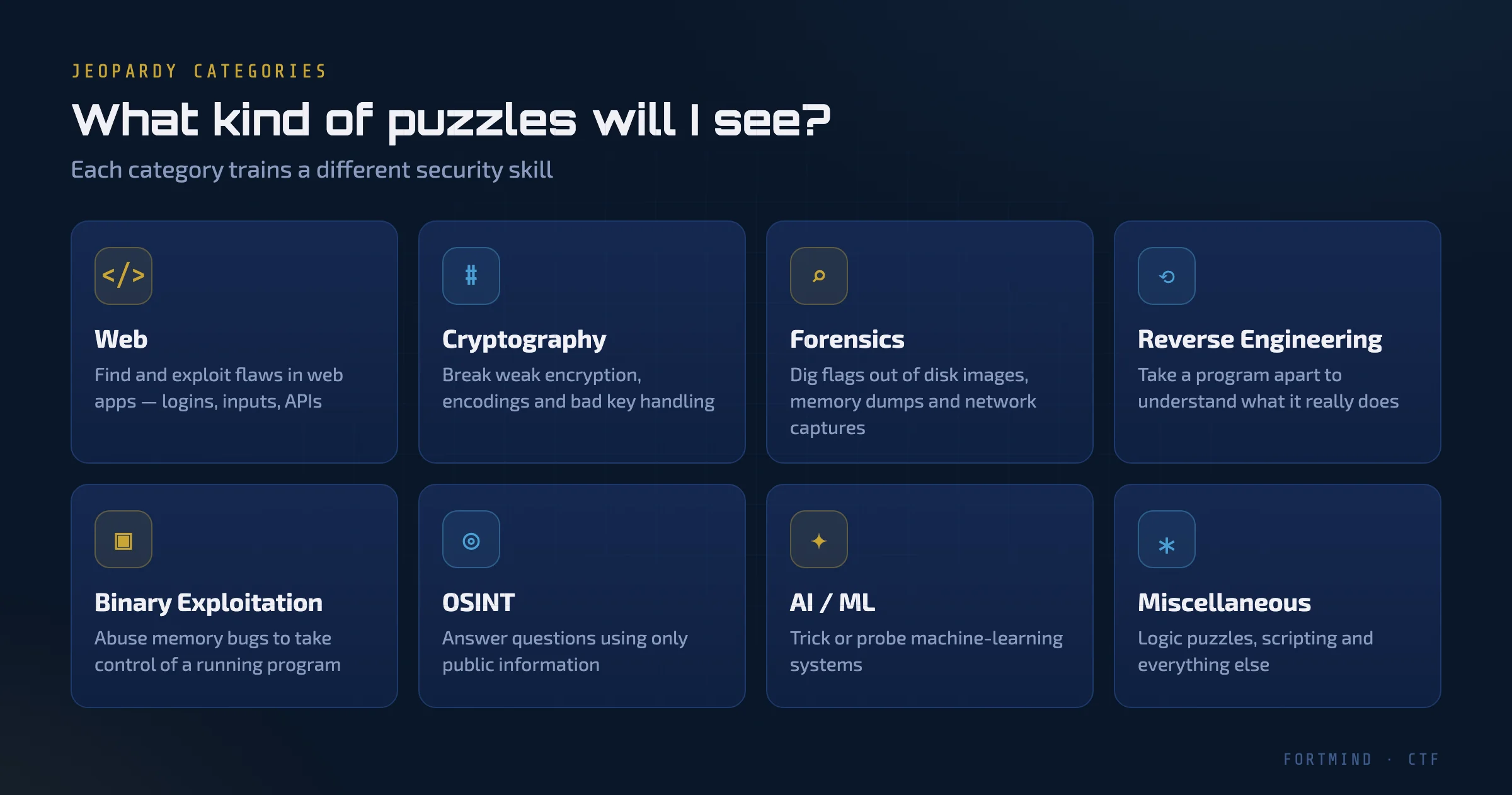
- Web: find and exploit flaws in web applications, such as broken logins, unsafe input handling, or exposed APIs.
- Cryptography: break weak encryption, spot bad encodings, or exploit mistakes in how keys are handled.
- Forensics: dig flags out of disk images, memory dumps, log files, or network captures.
- Reverse engineering: take a compiled program apart to work out what it really does.
- Binary exploitation (often called "pwn"): abuse memory bugs to take control of a running program.
- OSINT (open-source intelligence): answer questions using only publicly available information.
- AI / ML: probe or trick machine-learning systems.
- Miscellaneous: logic puzzles, scripting challenges, and anything that doesn't fit elsewhere.
Challenges also come in difficulty levels, from introductory to very hard. A good event has something for everyone.
Solo or Team?
You can play alone, and many people do. But CTFs really shine as a team activity.
No one is strong in every category. A team where one person loves web, another enjoys cryptography, and a third is patient with forensics can cover far more of the board than any one of them alone. Team play also teaches you to share what you find, ask for help early, and hand off a challenge when someone else has a better idea.
What a CTF Actually Trains
The obvious benefit is technical. But the less obvious benefits are just as valuable.
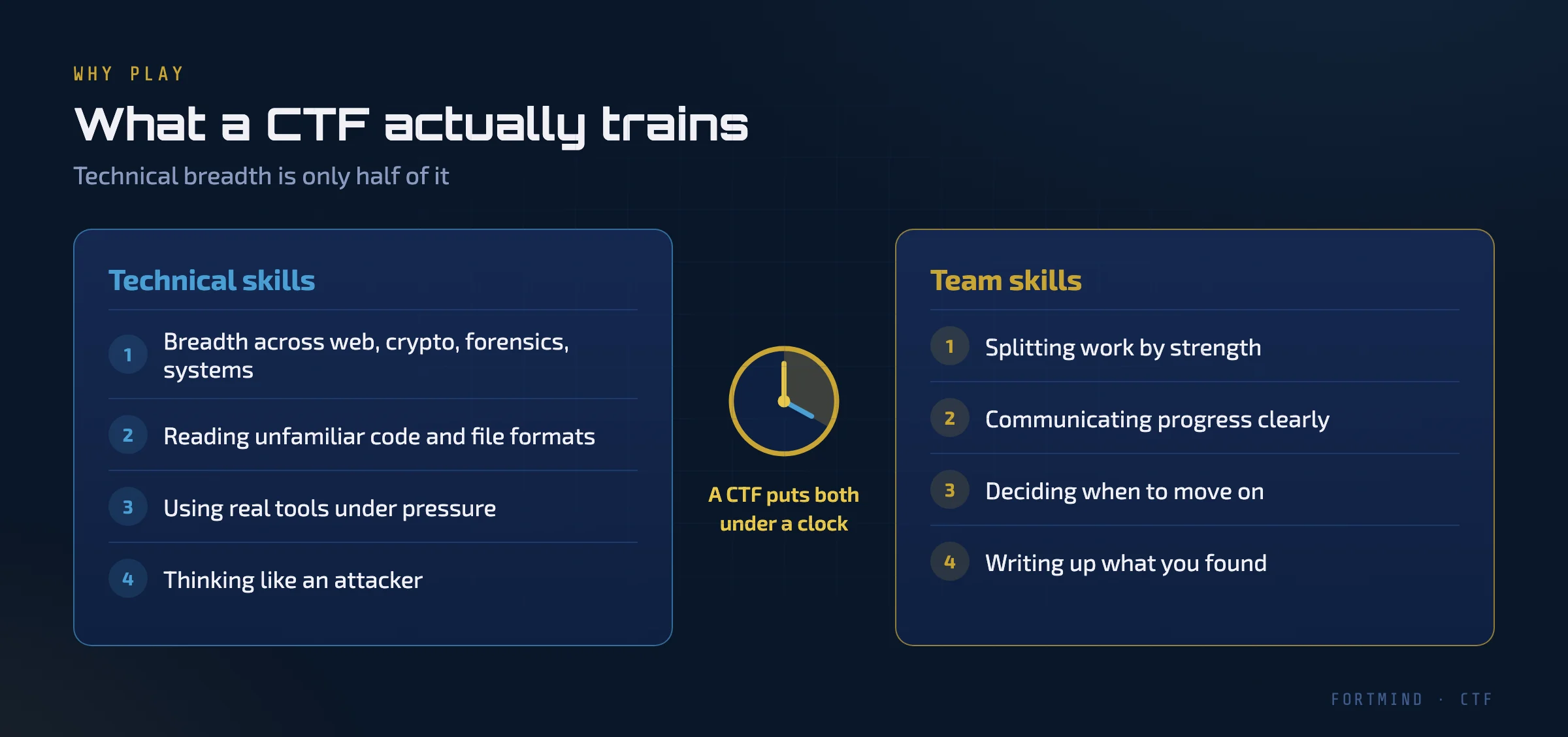
On the technical side, CTFs give you breadth. In one weekend you might touch web security, cryptography, file formats, and Linux internals. You learn to read unfamiliar code, use real tools, and, most importantly, think like an attacker: "what did the developer assume, and how can I break that assumption?"
On the team side, a CTF is practice for real incident work. You split tasks by strength. You keep each other updated. You decide when a challenge is a dead end and it is time to move on. And you write up what you found, so others can follow your steps.
All of this happens against a clock, which is exactly what makes it useful. Real security work is rarely calm and unhurried.
Why Companies Run CTFs
More organisations are using CTFs internally, for a few reasons:
- Training that sticks. People remember the vulnerability they exploited themselves far better than one they read about in a slide deck.
- Team-building with a purpose. A CTF gets developers, IT staff, and security people working on the same problems, and it shows each group how the others think.
- Finding hidden talent. CTFs reveal who is curious, persistent, and good at learning under pressure. That is useful for hiring and for spotting people who could grow into security roles.
- Security awareness for developers. A developer who has broken a web app in a CTF writes more careful code afterwards.
- A safe place to practise. Teams can try offensive techniques legally, on targets built for the purpose, without touching production systems.
How to Get Started Without Getting Lost
The first CTF can feel overwhelming. These habits help.
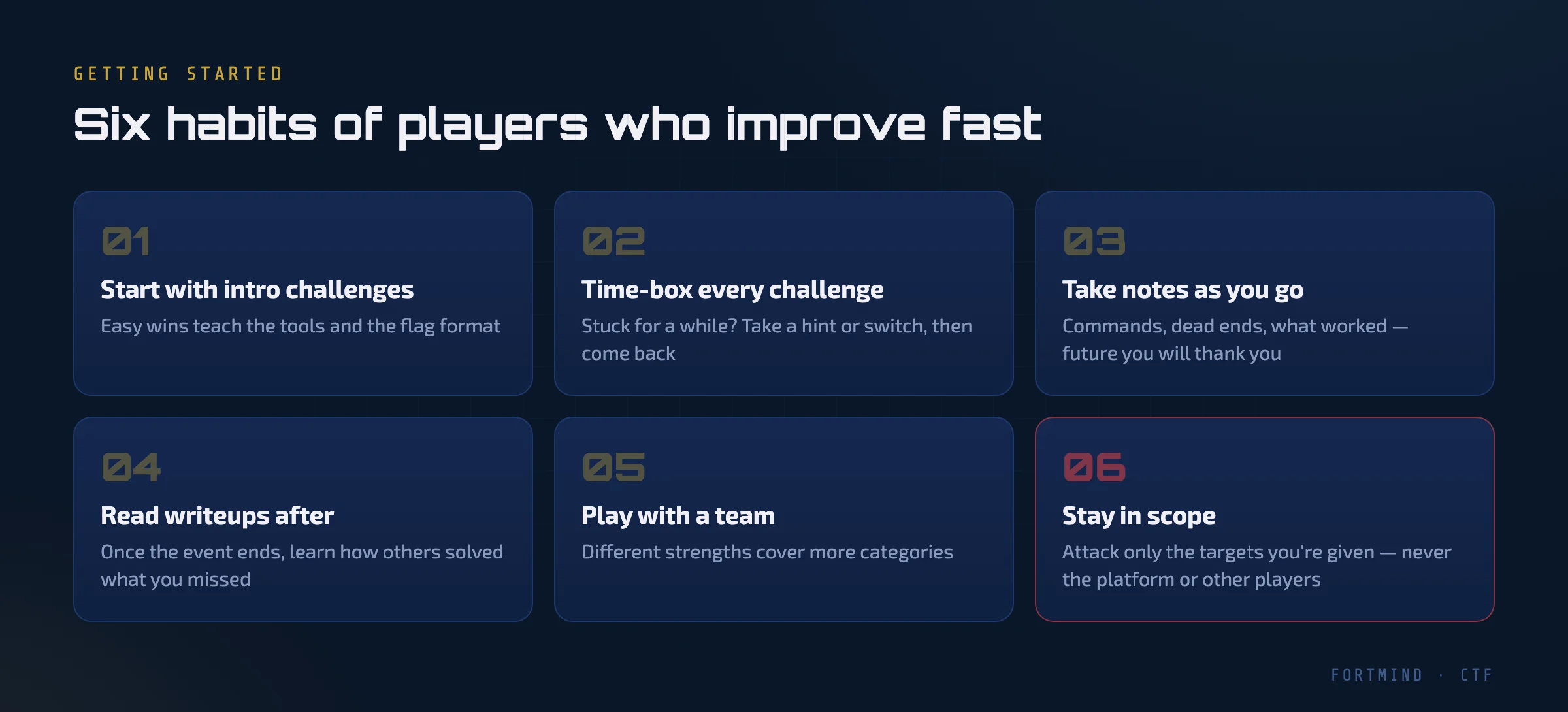
- Start with the intro challenges. They exist to teach you the platform, the flag format, and the basic tools. Early wins build momentum.
- Time-box every challenge. If you have been stuck for a while with no new ideas, take a hint, switch to another challenge, or ask a teammate. Coming back later with fresh eyes often works.
- Take notes as you go. Write down the commands you ran, what failed, and what worked. You will need them for the writeup, and for the next CTF.
- Read writeups after the event. Once a CTF ends, players often publish explanations of how they solved each challenge. Reading the solutions to challenges you missed is one of the fastest ways to improve.
- Play with a team. Even a team of two covers more ground, and you will learn from watching how others approach a problem.
- Stay in scope. Attack only the targets you are given. Never attack the CTF platform itself, the infrastructure behind it, or other players. Don't share flags or solutions while the event is running. A CTF only works when everyone plays fair.
How a CTF Works on FortMind
FortMind runs its own CTF platform, built on the same browser-based approach as our training labs. Players don't need a VPN or any special software.
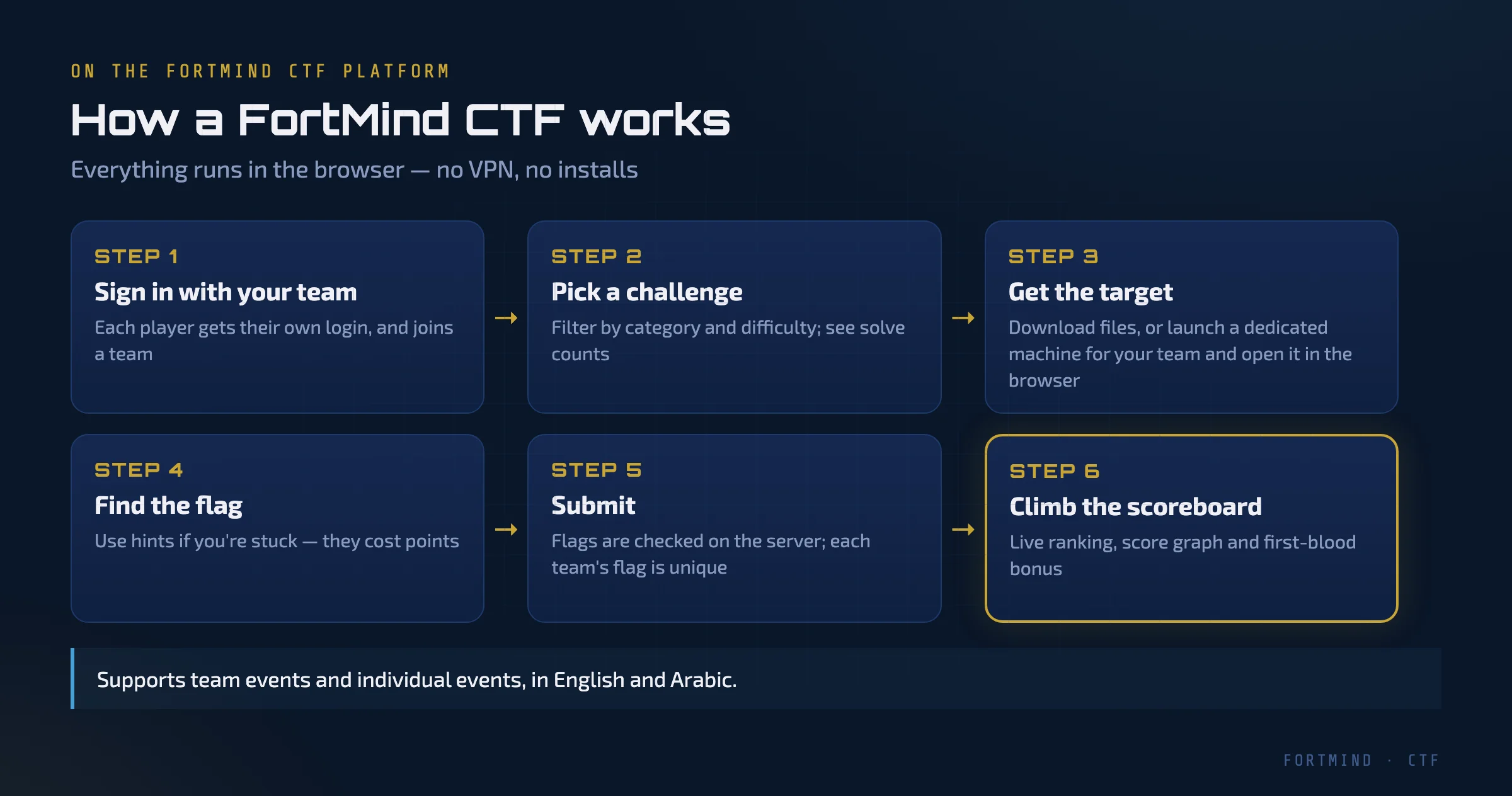
- Sign in with your team. Every player gets their own login and belongs to a team. Events can also run in individual mode, where everyone competes alone.
- Pick a challenge. The challenge board can be filtered by category and difficulty, and shows how many teams have solved each challenge, and who got first blood.
- Get the target. Some challenges come with files to download. Others come with a dedicated machine that your team launches with one click and opens directly in the browser. Everyone on the team works on the same machine, and no other team can touch it.
- Find the flag. If you are stuck, challenges can offer hints, but hints cost points.
- Submit. Flags are checked on the server. Challenges can give every team its own unique flag, so a flag copied from another team won't work. Wrong guesses are rate-limited, so guessing at random doesn't pay.
- Climb the scoreboard. The live scoreboard ranks every team, with a score graph showing how the competition unfolded. Organisers can freeze the board near the end to keep the final result a surprise.
The whole portal works in both English and Arabic, and each player can switch languages at any time.
How scoring works
Each challenge has a base value. On top of that, two things can change your score.
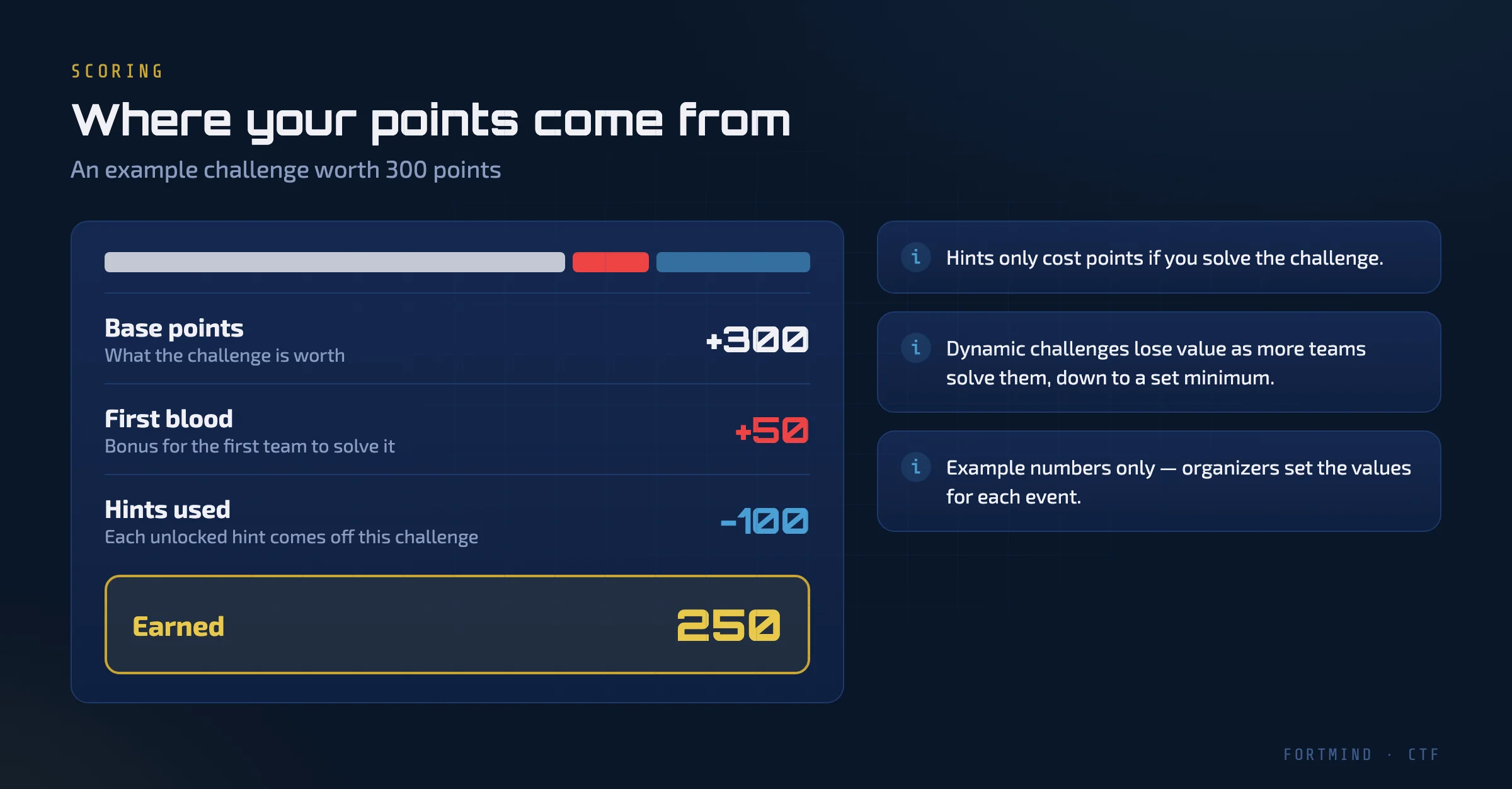
- First blood: the first team to solve a challenge can earn a bonus.
- Hints: each hint you unlock comes off that challenge's points, but only if you actually solve it. A hint you open on a challenge you never solve costs nothing.
Some challenges also use dynamic scoring: they start at a higher value and lose points as more teams solve them, down to a set minimum. That rewards teams who crack the hard problems that few others can.
Each challenge page shows your own breakdown (base points, first-blood bonus, and hint deductions), so you always know where your score comes from.
Ready to Play?
A CTF is the closest thing security has to a sport: clear rules, a scoreboard, and a lot of learning packed into a few hours. Whether you are a student trying your first challenge or a team lead looking for a training day your team will actually enjoy, it is worth trying.
Interested in running a CTF for your team or organisation? Get in touch with FortMind, and we will help you set it up.