Beyond the Hacker Myth: 5 Counter-Intuitive Truths About Modern Red Teaming
Real red teaming looks nothing like the movies. Five truths about how modern adversary operations work: business-impact objectives, why nothing is "OPSEC-safe", emulation vs. simulation, cyclical attack loops, and the rule of "first, do no harm".
Pop culture often depicts cyber attacks as fast-paced visual thrillers: a rogue operator typing frantically into a dark terminal, bypassing firewalls in seconds to gain instant "root" access or collapse a power grid.
In reality, genuine adversarial operations look nothing like cinematic tropes. Modern adversarial testing, known as red teaming, is not about frantically hunting software bugs, running unvetted exploits, or achieving arbitrary administrative privileges. It is a disciplined, highly structured measurement of an organization's people, processes, and technology under real-world threat conditions.
To understand how modern red teams operate, and why traditional compliance-driven security views fall short, here are five counter-intuitive truths about modern red teaming tradecraft.
Takeaway 1: "Domain Admin" Is Not the Goal. Business Impact Is.
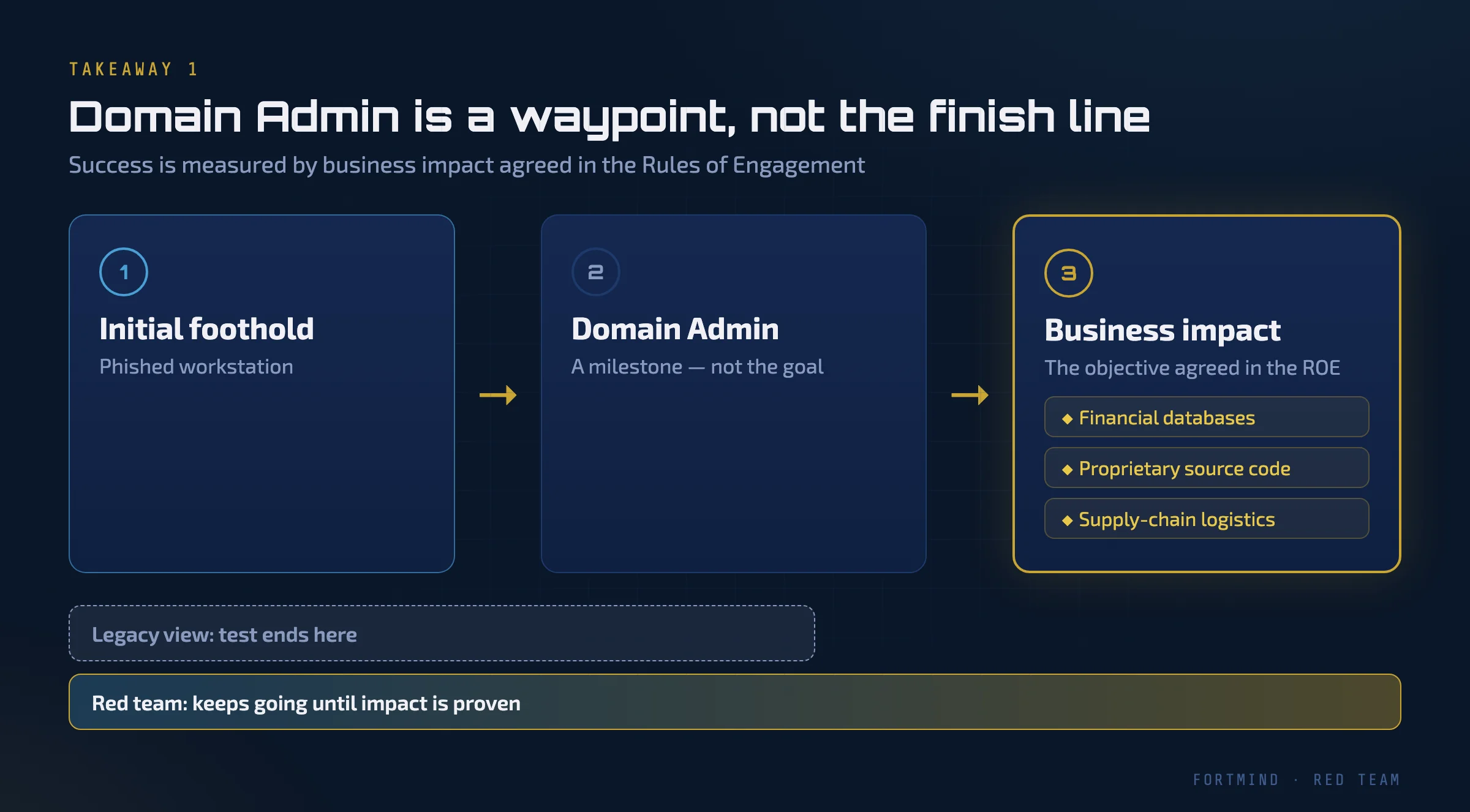
A lingering belief in legacy IT security is that gaining administrative control over an Active Directory domain, obtaining "Domain Admin", represents the ultimate objective of an attack. In red teaming, however, Domain Admin is rarely the end state. It is merely a stepping stone toward a far more critical outcome.
The true objective of a red team engagement is defined within the contractually binding Rules of Engagement (ROE): to measure pre-agreed operational outcomes tied directly to real business risk. Rather than stopping at elevated network permissions, operators focus on reaching business-critical systems or datasets and demonstrating concrete operational impact, such as accessing financial databases, compromising proprietary source code, or manipulating supply-chain logistics.
To understand how these attacks are constructed, security strategists categorize operator actions using a formal hierarchy of Tactics, Techniques, and Procedures (TTPs):
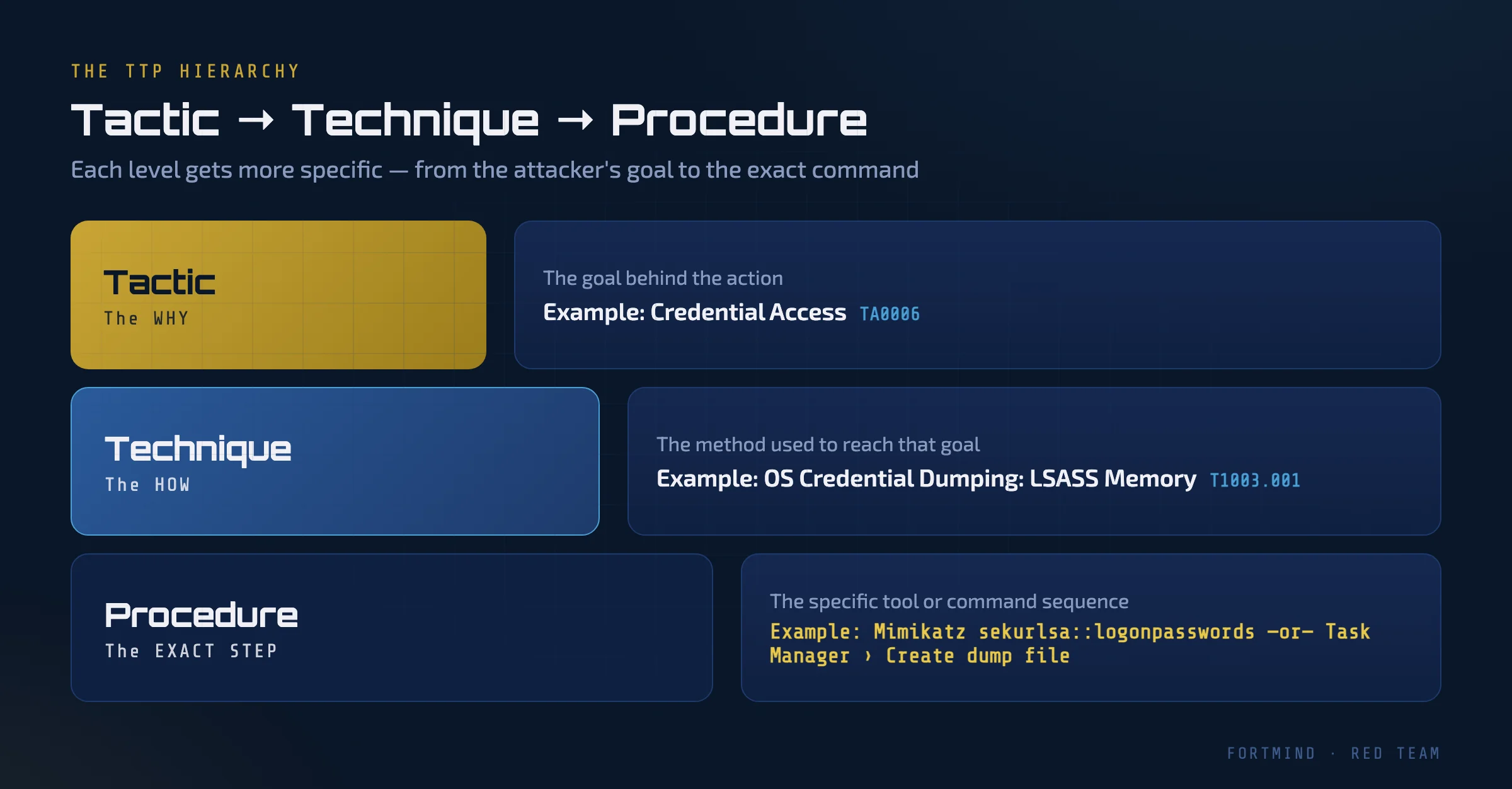
- Tactic (the "why"): the tactical goal behind an action (e.g. Credential Access).
- Technique (the "how"): the functional method used to achieve that goal (e.g. dumping LSASS memory).
- Procedure (the exact step): the specific tool execution or command sequence used to perform the technique (e.g. a Mimikatz logon-password dump versus a Task Manager process dump).
"Red teaming is the use of real-world tactics, techniques and procedures (TTPs) to emulate a genuine threat, in order to measure the effectiveness of the people, processes and technology an organisation relies on to defend itself."
Focusing on business impact rather than arbitrary access elevates security testing to executive relevance. Executives do not evaluate organizational risk based on network permissions; they evaluate it by potential damage to core business operations. When security assessments halt at "Domain Admin", IT departments tend to patch superficial symptoms. By demonstrating how an adversary uses TTPs to reach core business assets, red teaming aligns technical evaluations with broader enterprise risk management.
Takeaway 2: There Is No Such Thing as "OPSEC-Safe"
In adversary operations, Operations Security (OPSEC) measures how likely a blue team (the defenders) is to observe and interrupt an operator's activity. A major misconception among security practitioners is that certain commands, scripts, or C2 (Command and Control) frameworks are inherently "OPSEC-safe", while others are strictly "unsafe".
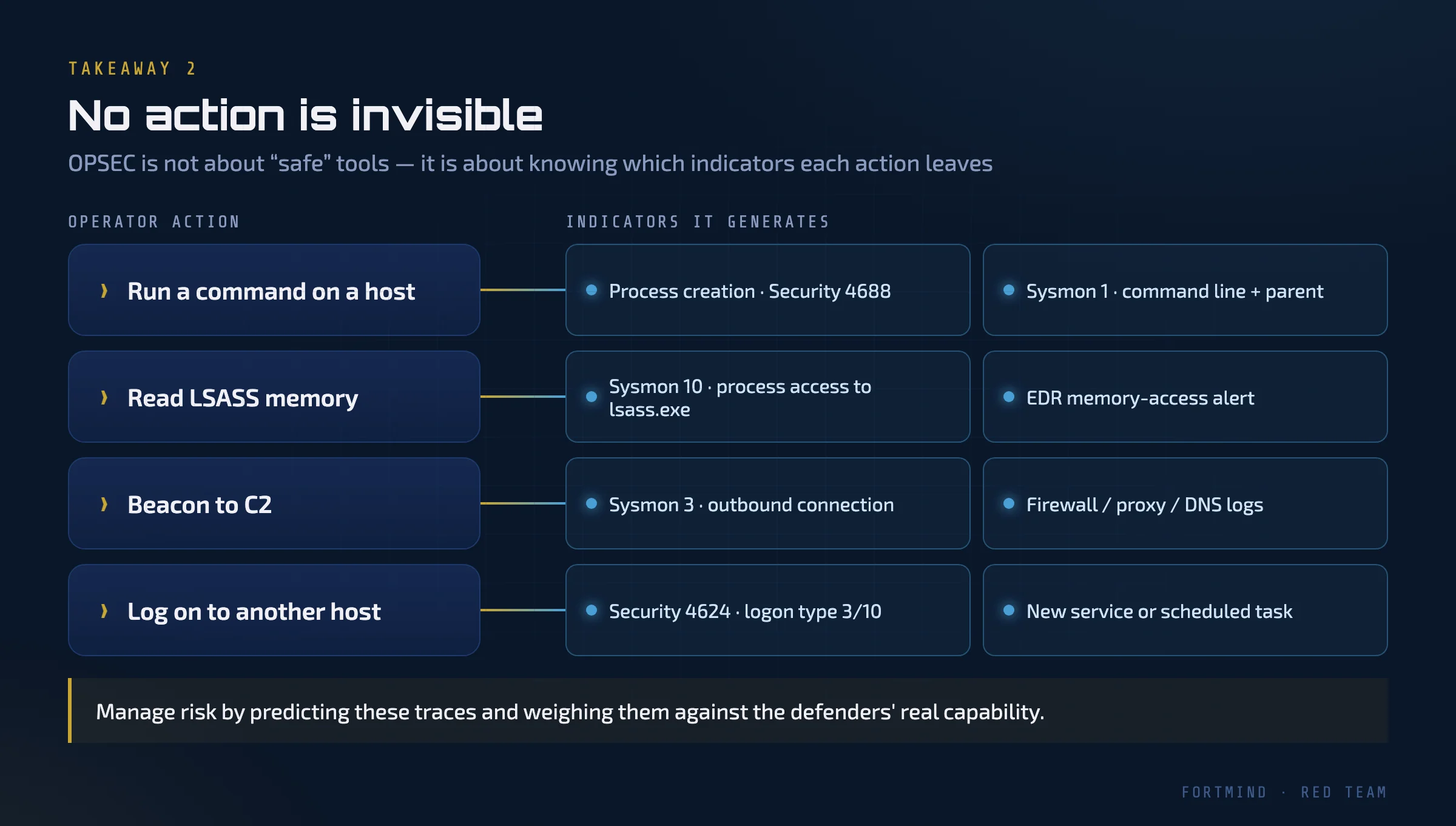
In practice, no security action is 100% invisible. Every command, network connection, or process execution generates digital artifacts across workstations, servers, and firewalls.
"There is no such thing as 'OPSEC-safe' or 'OPSEC-unsafe'. There are only actions and the indicators those actions generate."
Crucially, OPSEC considerations primarily govern threat simulation engagements, where operators have the freedom to select stealthy, custom tradecraft. In threat emulation, operators are bound to the documented TTPs of a specific threat actor, however noisy or detectable those actions may be.
Effective tradecraft does not rely on searching for an imaginary, indicator-free tool. It requires a granular understanding of the telemetry left behind. Operators manage detection risk not by assuming their actions are invisible, but by anticipating the precise indicators generated across workstation event logs, process creation events, and LSASS memory access patterns, and balancing those indicators against the defensive capabilities of the target environment.
Takeaway 3: Threat Emulation vs. Simulation (and Why You Need Both)
Threat emulation and threat simulation both imitate adversarial behavior, but they serve distinct strategic purposes and operate under different scope constraints.
| Feature | Threat Emulation | Threat Simulation |
|---|---|---|
| Target | Specific known threat actor | Broad or hypothetical threat |
| Scope | Narrow, intelligence-led | Broad, exploratory |
| Goal | Baseline detection of known TTPs | Test detection against novel or varied TTPs |
Modern red teams ingest Cyber Threat Intelligence (CTI) using standardized formats like STIX/TAXII (Structured Threat Information eXpression / Trusted Automated eXchange of Intelligence Information) and map techniques directly to the MITRE ATT&CK framework.
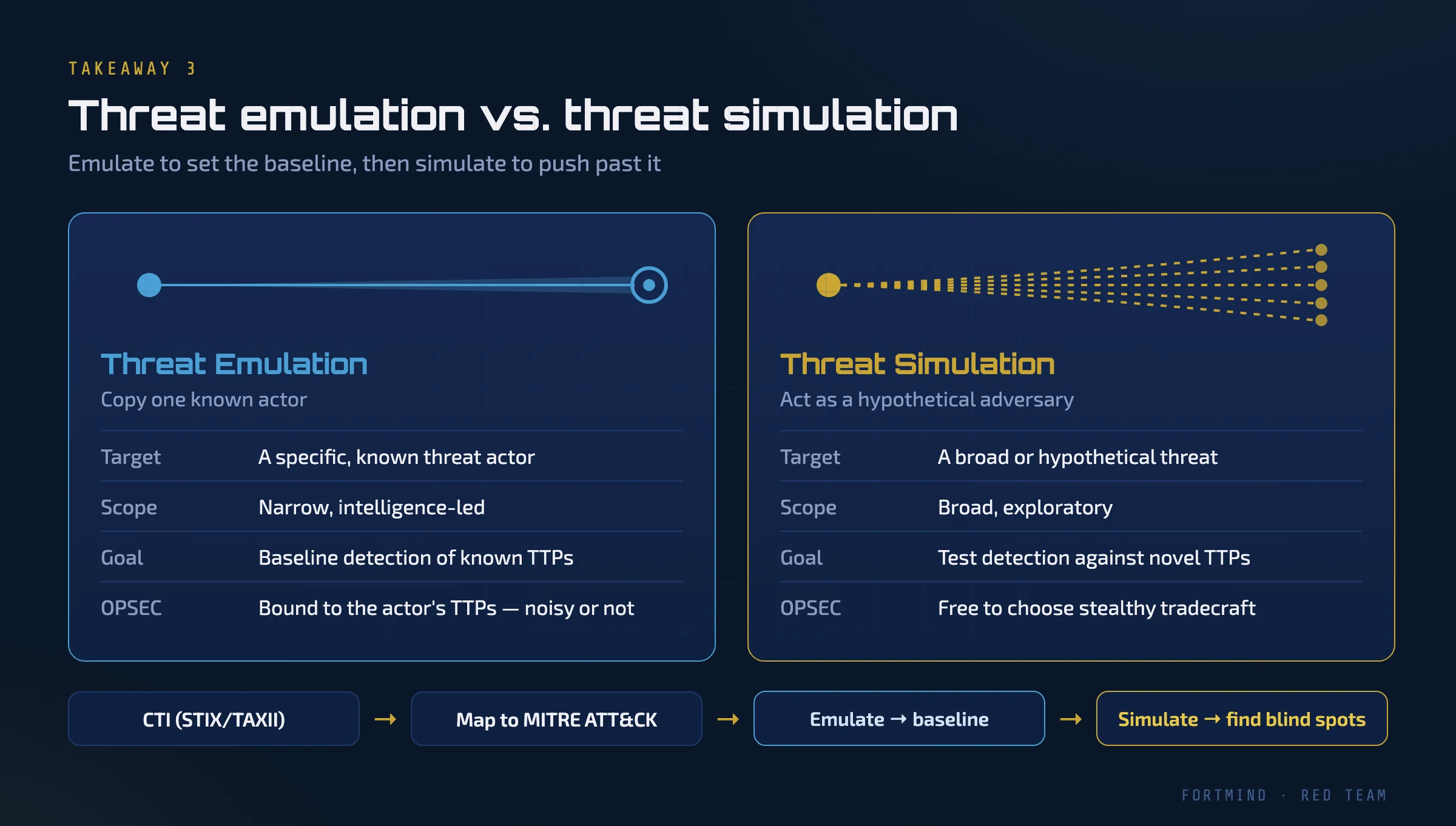
In threat emulation, operators draw on threat intelligence reports to mirror the exact TTPs of a specific threat actor known to target the client's industry. This narrow focus validates whether existing detection signatures and SIEM rules catch a known adversary. In threat simulation, operators act as hypothetical adversaries with free choice of TTPs, using novel living-off-the-land techniques and custom C2 channels to uncover unknown blind spots in the organization's defensive posture.
A fundamental rule of thumb: use threat emulation to set a baseline detection capability against known threats, then use threat simulation to push past that baseline against varied and novel TTPs.
Takeaway 4: Real Cyber Attacks Are Cyclical Loops, Not Linear Chains
Traditional attack frameworks, such as the Lockheed Martin Cyber Kill Chain, depict attacks as a linear seven-phase progression ending at "Actions on Objectives". While historically foundational, linear models have a major limitation: they say little about post-compromise activity inside an enterprise network.
To address this gap, industry models evolved. The Mandiant Targeted Attack Lifecycle introduced an eight-phase model (Initial Recon, Initial Compromise, Establish Foothold, Escalate Privileges, Internal Recon, Move Laterally, Maintain Presence, Complete Mission) that provided much-needed visibility into internal lateral movement.
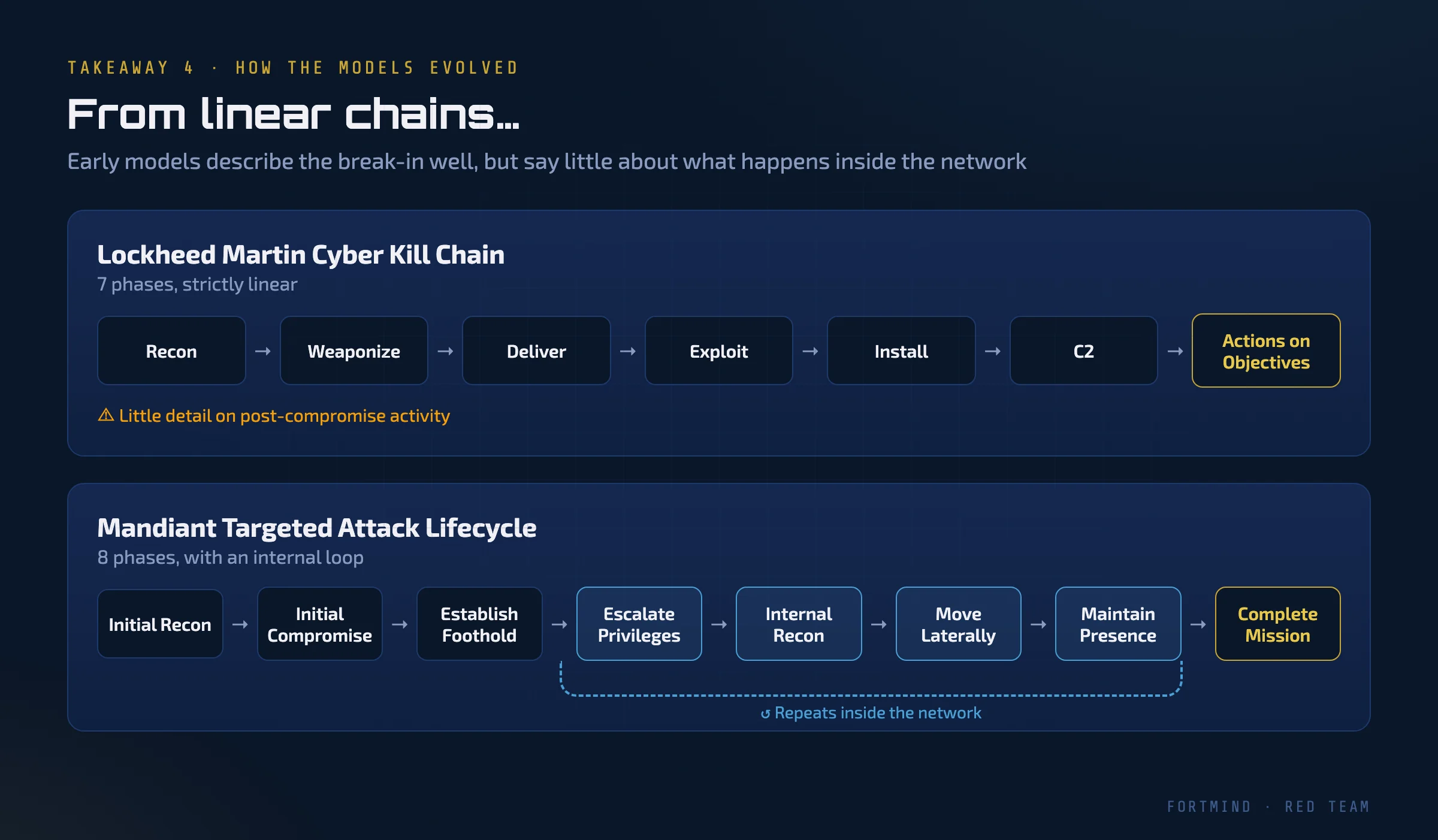
Modern operational strategy, however, relies heavily on the Microsoft cyclical model, which recognizes that internal enterprise attacks do not move in straight lines. They loop through repeating phases over extended timelines.
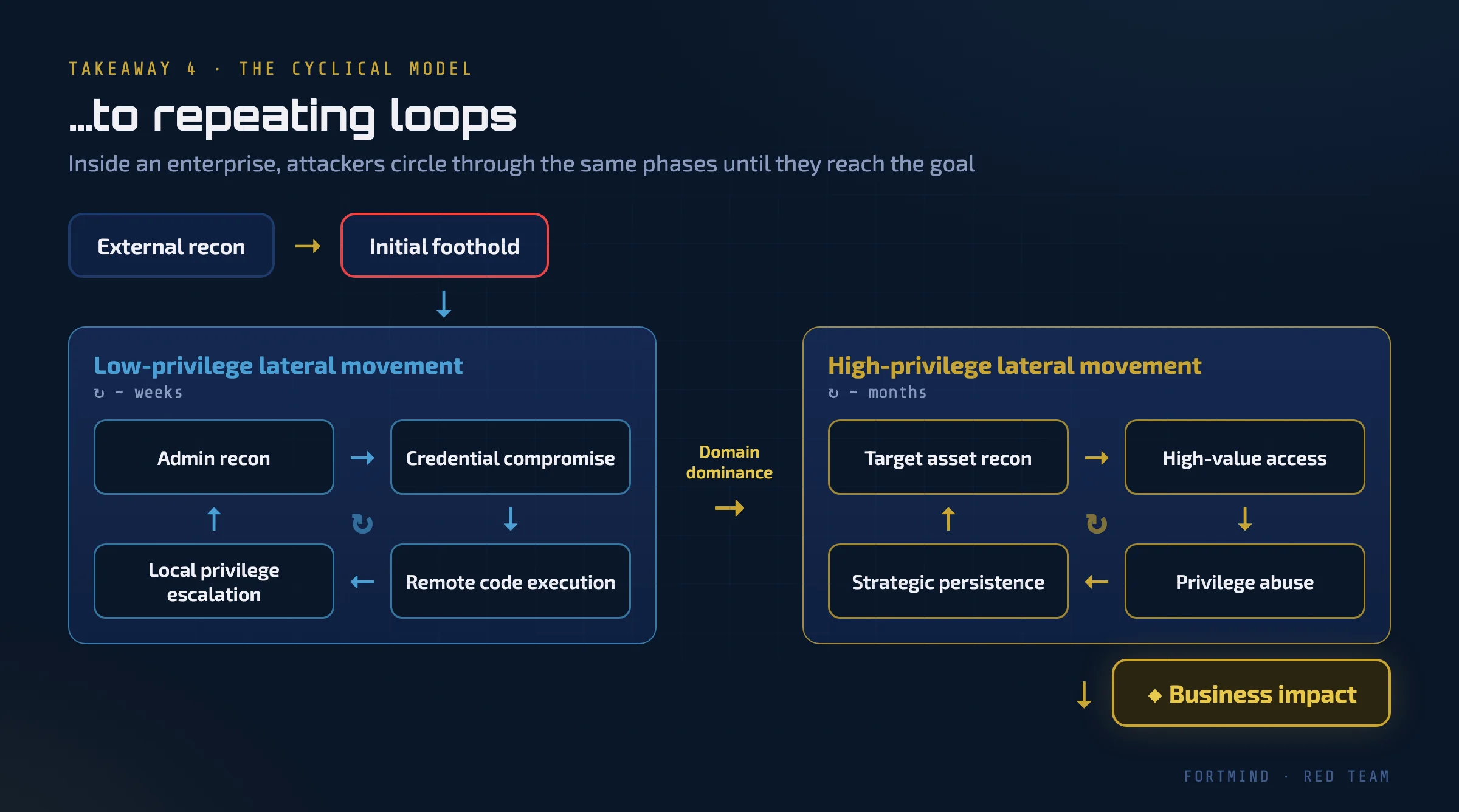
Internal campaigns are structured around two distinct operational cycles:
- Low-privilege lateral movement cycle (~weeks): after securing an initial foothold, the operator enters an iterative loop: admin reconnaissance → credential compromise (e.g. harvesting LSASS memory or registry stores) → remote code execution → local privilege escalation. This loop repeats across multiple workstations for weeks until sufficient domain access is acquired.
- High-privilege lateral movement cycle (~months): after acquiring Domain Admin credentials and achieving domain dominance, a second, more deliberate cycle begins. The operator conducts targeted asset reconnaissance, pivots across high-value server enclaves, and maintains persistent access over months to identify, access, and demonstrate impact against core business databases.
Takeaway 5: "Primum Non Nocere". Prove Access, Don't Steal Data.
Red team engagements operate under the foundational rule of primum non nocere: "first, do no harm". Although red teams legitimately carry out high-risk maneuvers, such as deploying C2 implants or escalating privileges, operators must never introduce unmanaged risk into a client's live production environment.
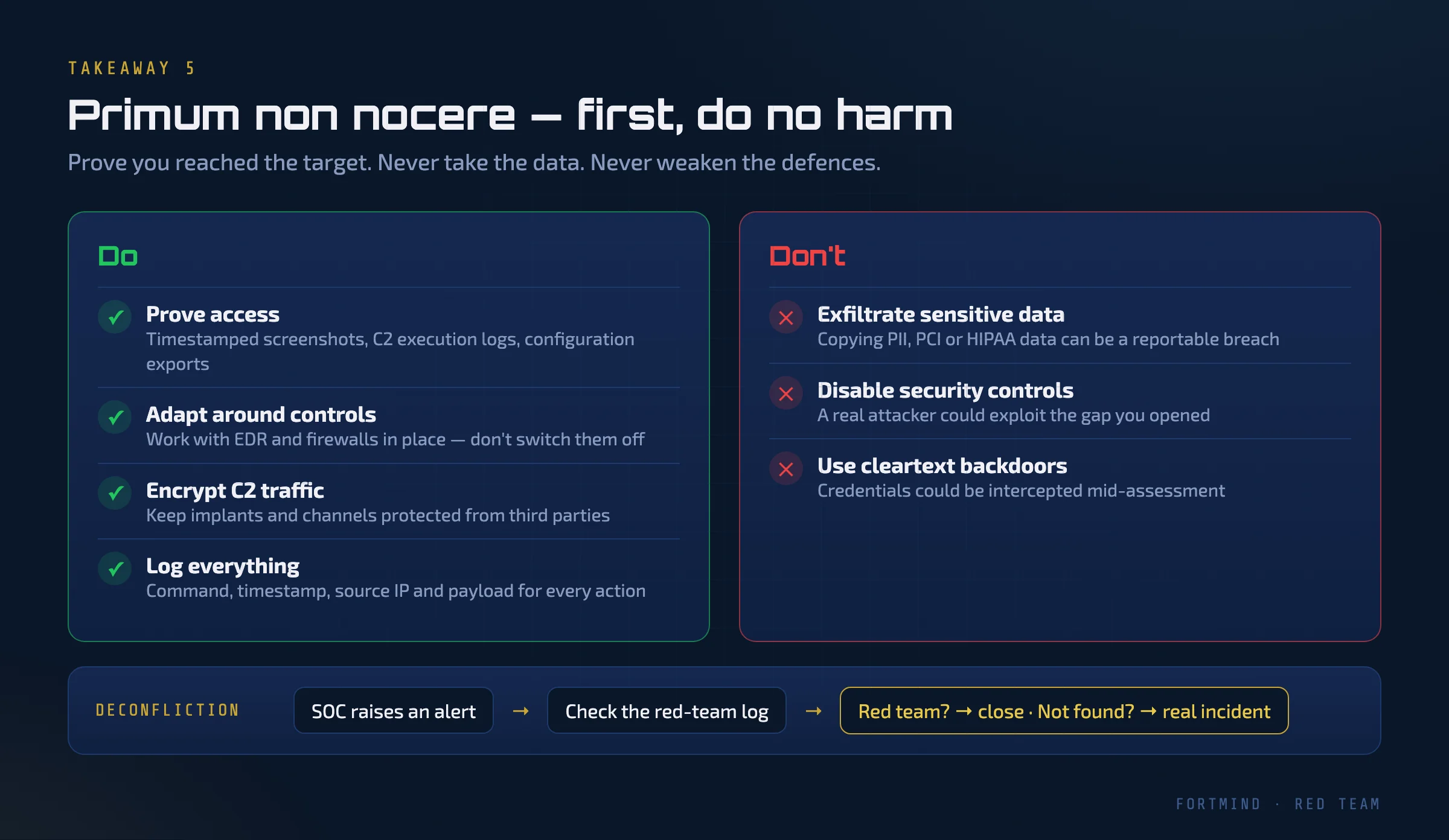
This principle governs tradecraft in two critical ways.
1. Control integrity and third-party exposure
Operators must never simply disable security controls (such as turning off Endpoint Detection and Response agents or lowering host firewalls) or deploy unencrypted C2 backdoors. Tearing down defensive controls or transmitting cleartext traffic exposes the client to serious third-party risk: a real external adversary monitoring the network could exploit those weakened defenses or intercept cleartext credentials mid-assessment. Tradecraft must adapt around security controls, not destroy them.
2. Proof of access vs. data exfiltration
While demonstrating business impact is the ultimate objective, exfiltrating real sensitive datasets, such as customer Personally Identifiable Information (PII), Payment Card Industry (PCI) records, or HIPAA-protected health data, can constitute a genuine, legally reportable data breach.
To satisfy engagement objectives safely, operators capture authoritative proof of access. Using timestamped screenshots, C2 execution logs, and configuration exports, they prove they reached a target database without copying or removing sensitive records from the network.
Meticulous logging and deconfliction
Adhering to primum non nocere requires rigorous record-keeping. Red teams log every executed command, timestamp, source IP, and implant payload. These logs are vital for deconfliction: if the client's Security Operations Center (SOC) detects suspicious activity mid-assessment, thorough logging lets defenders immediately verify whether the alert comes from the red team's activity or from a real-world attack.
Conclusion: Rethinking Security Strategy
Understanding modern red teaming tradecraft forces a fundamental shift in defensive strategy. Security posture cannot be judged merely by the absence of unpatched software vulnerabilities or the completion of annual compliance checklists. True resilience is measured by how effectively human defenders (the blue team), incident response processes, and security telemetry detect and contain an active, adaptive threat.
By moving past pop-culture tropes and embracing the realities of adversary TTPs, security leaders can turn raw event logs into real defensive strength.
If an adversary targeted your core business asset today, would your defenses catch the subtle indicators left behind, or are you still measuring security by the presence of software patches alone?