
Pentest vs. Red Team vs. Vulnerability Scan: What Does Your Company Actually Need?
Three security services that sound alike but answer very different questions. What each one does, how they build on each other, which one fits your maturity today, and what to ask any provider before you sign.
Sooner or later, every IT manager gets the same request from leadership, an auditor, or a customer: "We need a security test." Then the quotes arrive, and they use three terms that sound alike but mean very different things: vulnerability scan, penetration test, and red team engagement.
Pick the wrong one and you either pay for depth you can't use yet, or you get a report that looks reassuring and proves very little. This guide explains what each one actually does, how they fit together, and how to choose the right one for where your organization is today.
Three Different Questions
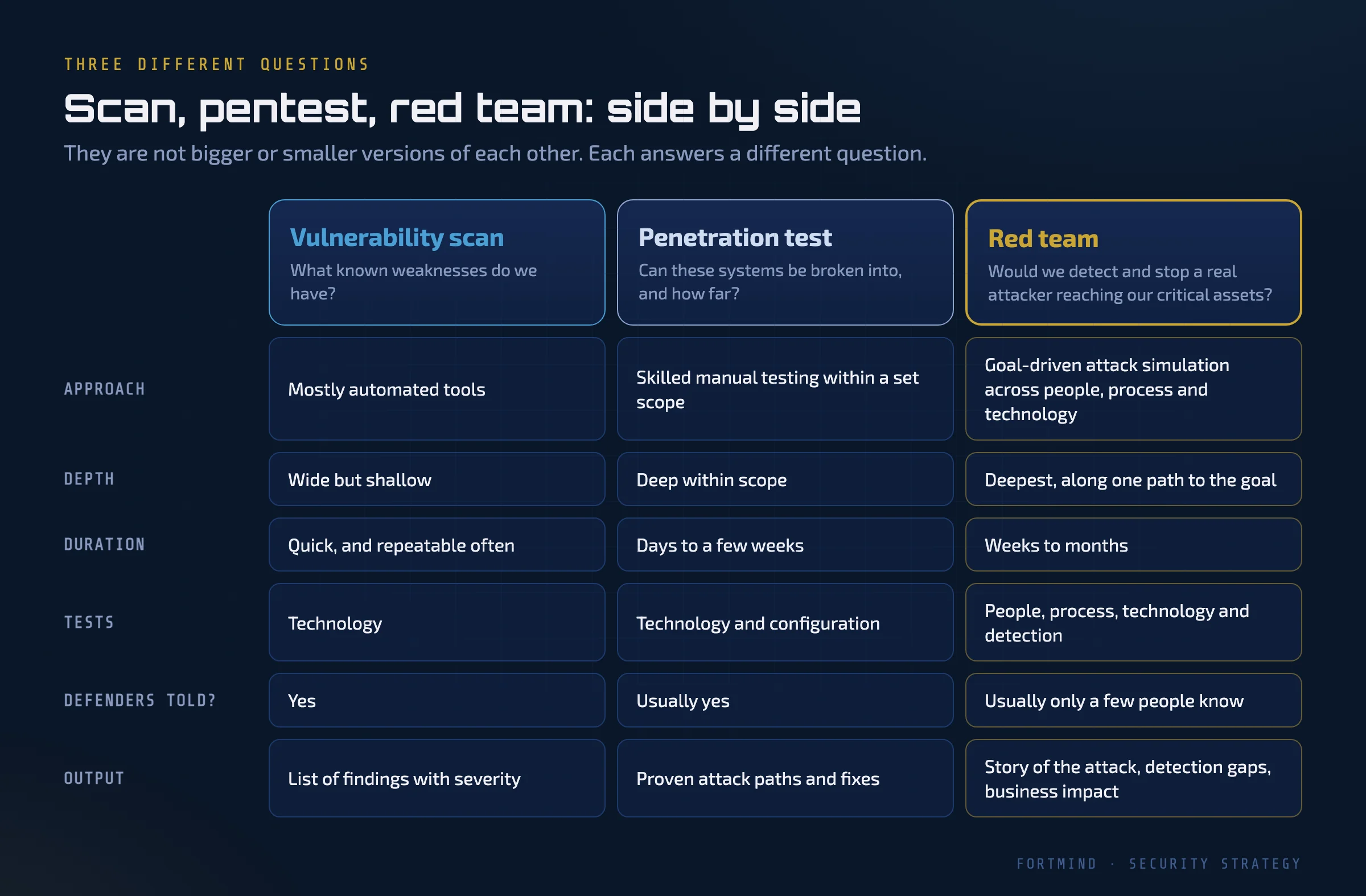
The simplest way to tell them apart is to look at the question each one answers. They are not bigger or smaller versions of the same service.
- A vulnerability scan asks: what known weaknesses do we have?
- A penetration test asks: can these specific systems be broken into, and how far could an attacker get?
- A red team engagement asks: if a real attacker came after our most important assets, would we notice and stop them in time?
Vulnerability scan
A scan uses automated tools to check your systems against a large database of known weaknesses: missing patches, outdated software, weak configurations, exposed services. It is fast, broad, and cheap enough to run often. Many organizations run scans on a regular schedule and after every significant change.
What a scan does not do is prove anything. It reports what might be exploitable. It cannot tell you whether three "medium" findings can be chained together into a full compromise, and it will produce false positives that someone has to check by hand.
Who it tests: technology only. What you get: a list of findings ranked by severity.
Penetration test
A penetration test (pentest) is skilled people, working manually, trying to break into an agreed set of systems: a web application, an internal network, a cloud environment, a mobile app. They use tools, but the value comes from human judgment: exploiting a weakness, combining small issues into a serious one, and going as far as the scope allows.
Pentests are usually measured in days or a few weeks, depending on scope. Your IT team normally knows the test is happening.
Who it tests: technology and configuration. What you get: proven attack paths, evidence, and specific fixes.
Red team engagement
A red team works toward a goal rather than a list of systems. As we covered in Beyond the Hacker Myth, the objective is set in the Rules of Engagement and tied to real business impact: for example, reaching the finance system or the source code repository. The team may use phishing, physical access, or any path a real attacker would take, within the agreed rules.
Red team engagements typically run for weeks to months, and usually only a small group in the organization knows about them. That is the point: the engagement tests whether your people, processes, and detection tools respond to a realistic attack, not just whether a server is vulnerable.
Who it tests: people, process, technology, and detection, together. What you get: the story of the attack, where detection worked and where it failed, and what the business impact would have been.
Breadth vs. Depth
Another useful way to compare them is coverage. A scan sees almost everything, but only on the surface. A pentest goes deep inside an agreed scope. A red team ignores most of the estate and follows one path all the way to the goal.
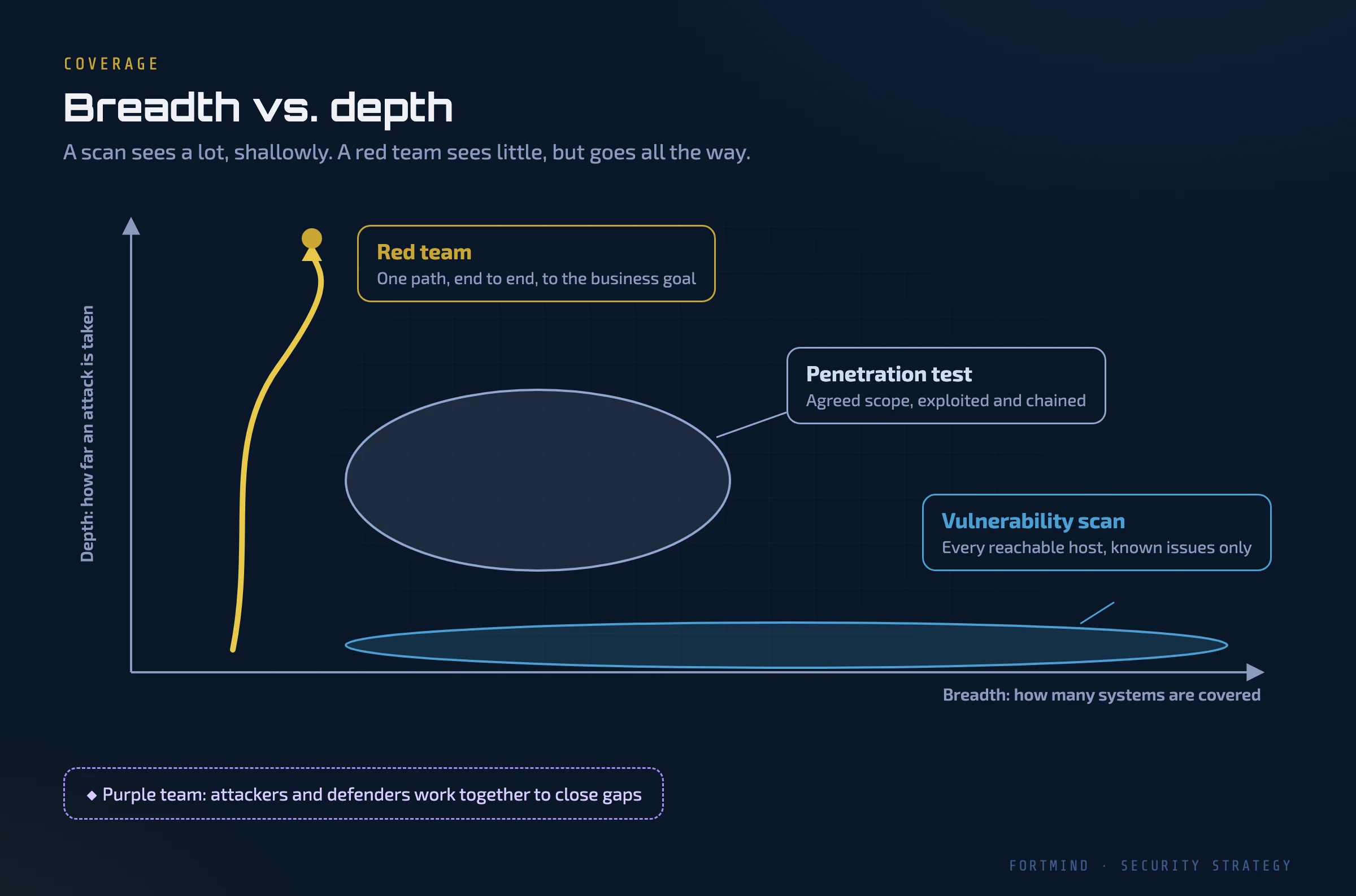
None of these is "better". A red team can reach the crown jewels and still leave a hundred unpatched servers unexamined. A scan can list a hundred issues without showing which one actually matters. You need the right tool for the question you are asking.
There is also a fourth option worth knowing: the purple team. Here, attackers and defenders work side by side. The red side runs a technique, the blue side checks whether they saw it, and together they fix the gap before moving on. It is one of the fastest ways to improve detection once the basics are in place.
Climb in Order
These services build on each other. Each step makes the next one worth paying for.
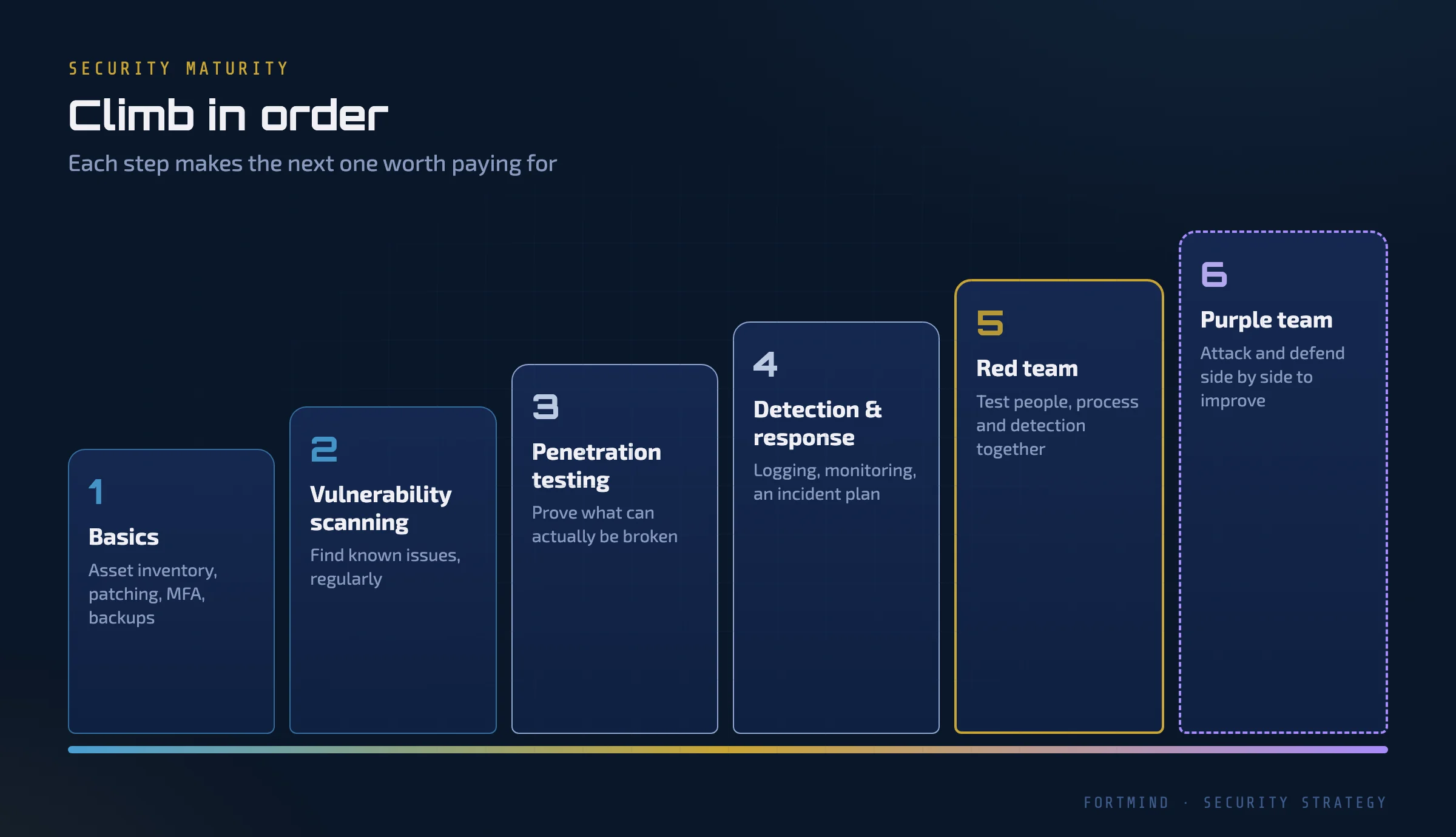
- Basics. Know what assets you have, patch them, turn on multi-factor authentication, and keep tested backups.
- Vulnerability scanning. Find known issues regularly and track them to closure.
- Penetration testing. Prove what can really be broken, especially before launching something new or after a major change.
- Detection and response. Collect the right logs, monitor them, and have an incident response plan people have practised.
- Red team. Test whether all of the above works together against a realistic attacker.
- Purple team. Use attack and defence together to improve, technique by technique.
Skipping steps is expensive. A red team against an organization with no monitoring will simply walk in, and the report will tell you what a scan and a pentest could have told you for far less.
Which One Do You Need?
If you are unsure, answer these questions in order and stop at the first "no".
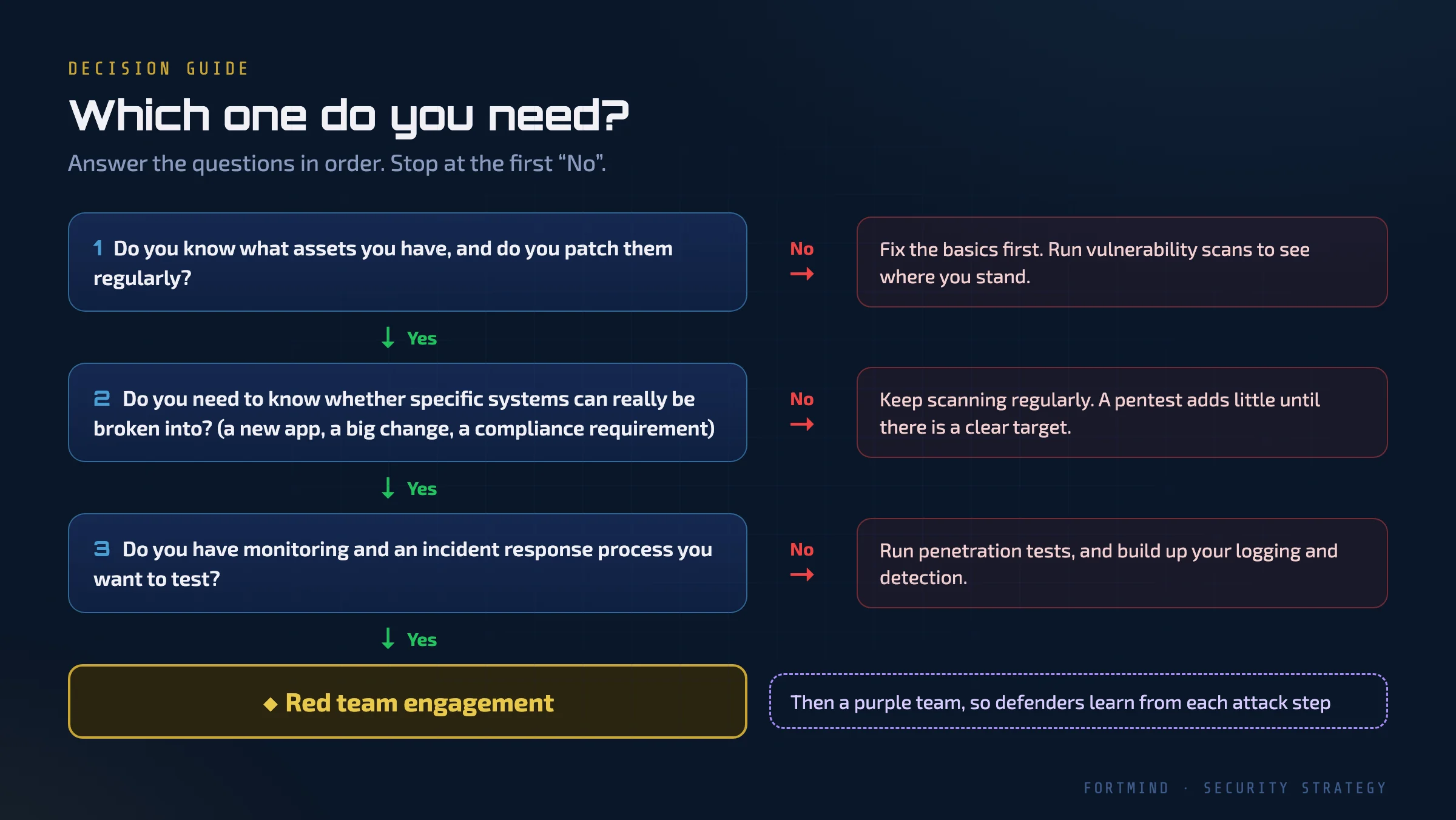
- Do you know what assets you have, and do you patch them regularly? If not, start with the basics and run vulnerability scans to see where you stand.
- Do you need to know whether specific systems can really be broken into? A new customer-facing app, a major infrastructure change, or a compliance requirement are common triggers. If yes, a penetration test is the right tool.
- Do you have monitoring and an incident response process you want to test? If not, keep running pentests and invest in logging and detection first.
- If you answered yes to all three, a red team engagement will give you the most value, followed by purple team exercises so your defenders learn from every step.
Questions to Ask Any Provider
Whatever you buy, the quality of the provider matters as much as the type of test. A good provider will answer these questions clearly and in writing before any work begins.
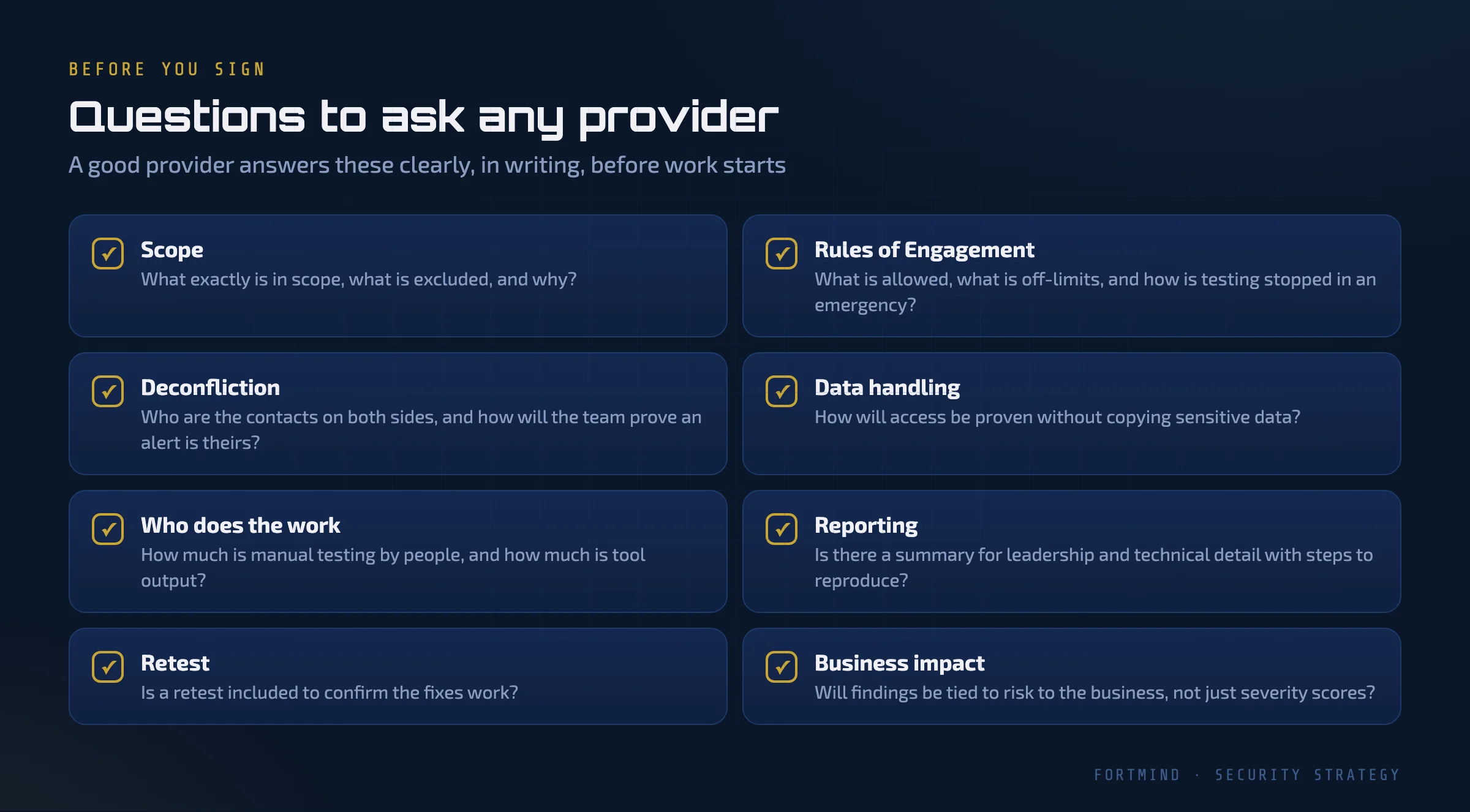
- Scope: what exactly is included, what is excluded, and why?
- Rules of Engagement: what is allowed, what is off-limits, and how can testing be stopped immediately if something goes wrong?
- Deconfliction: who are the contacts on both sides, and how will the team prove that a suspicious alert is theirs and not a real attack?
- Data handling: how will they prove access without copying sensitive data? A responsible team captures evidence such as screenshots and logs, not your customer records. This is the "first, do no harm" principle in practice.
- Who does the work: how much is manual testing by experienced people, and how much is tool output?
- Reporting: will you get a short summary for leadership plus technical detail your team can act on, with steps to reproduce each finding?
- Retest: is a retest included to confirm your fixes actually work?
- Business impact: will findings be explained in terms of risk to the business, not just severity scores?
If a provider struggles to answer these, that tells you something.
Common Buying Mistakes
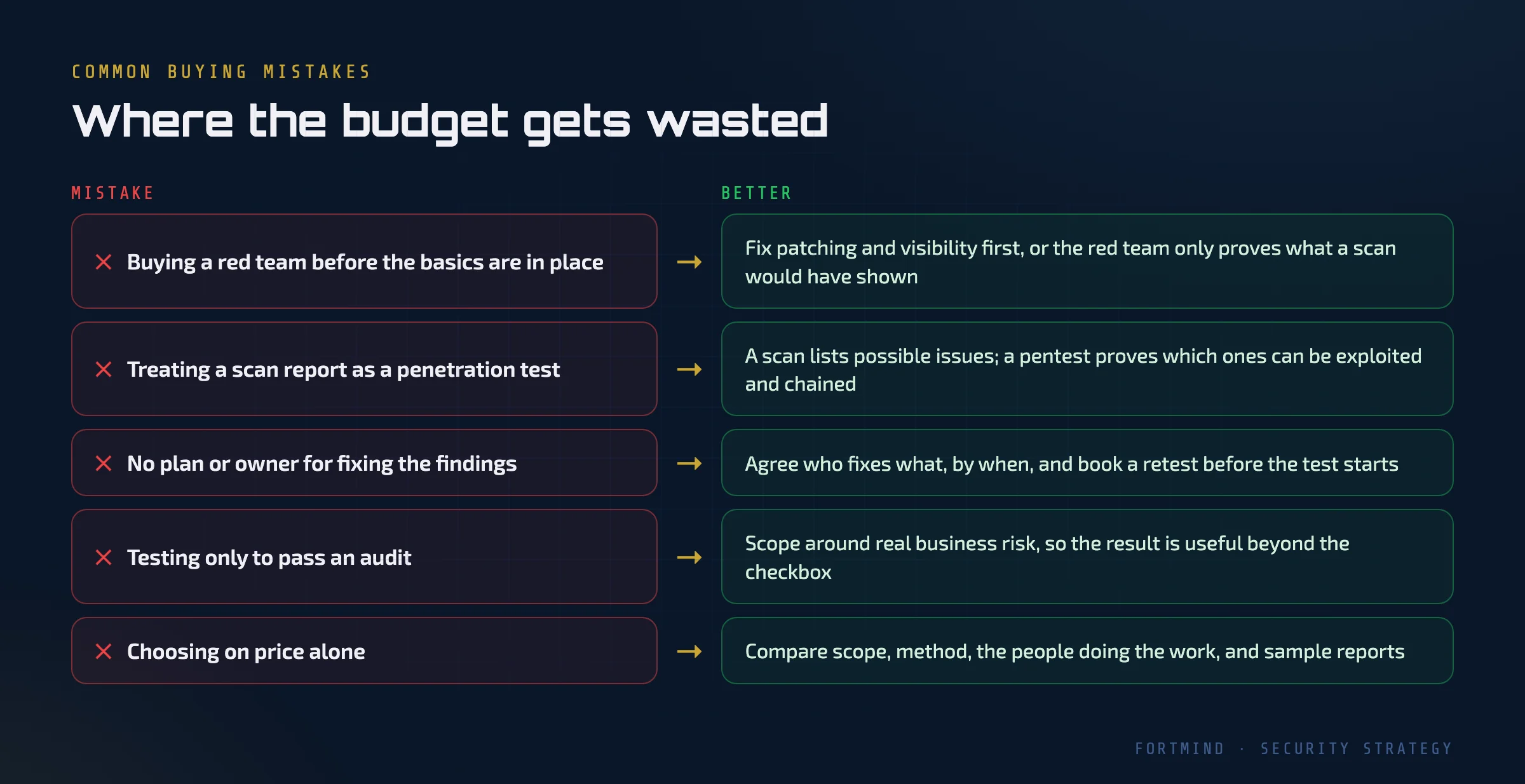
Buying a red team before the basics are in place. It sounds impressive, but if patching and visibility are weak, the red team will mostly confirm what cheaper testing would have found.
Treating a scan report as a penetration test. A scan lists possible issues. A pentest proves which ones can be exploited and how they combine. If a "pentest" report looks like raw tool output, ask questions.
No plan for fixing the findings. A test with no remediation plan is an expensive document. Before the test starts, agree who owns the fixes, set deadlines, and book the retest.
Testing only to pass an audit. Compliance is a valid reason to test, but scope the work around real business risk so the result is useful beyond the checkbox.
Choosing on price alone. Two quotes for "a pentest" can describe very different work. Compare scope, method, the experience of the people involved, and ask for a sample report.
Building the Skills In-House
Whichever service you buy, your own team has to understand the results, fix the issues, and defend against the next attack. That is where most organizations feel the gap.
At FortMind, we train teams on realistic, isolated cyber ranges that run in the browser. Your engineers can practise the same techniques testers use, learn to recognise them from the defender's side, and get comfortable reading and acting on a pentest or red team report. We also run corporate training programs shaped around your environment and your team's level.
The right test tells you where you stand. A trained team is what moves you up the ladder.